
Architect Cliff Tan began sharing his educational and comedic content about Feng Shui online during Covid and quickly became an internet sensation. As the creator behind the account @dearmodern he has attracted seven million followers across TikTok, YouTube and Instagram, where he shares practical tips for solving common interiors problems with enthusiasm and plenty of humour. Cliff is the author of bestselling book, Feng Shui Modern, and in his new book, Feng Shui Fix It! 100 Solutions for a Happier Home, published in October 2026, he explains the 100 most important Feng Shui beliefs about our homes, what they mean for modern life, and how to fix any faux pas. His aim is simple: he wants you to feel happy to be home the moment you step foot inside your front door.
- ‘Accessibility and beautiful design can go hand in hand – even small details can be transformative’
- TV DIY expert Nick Knowles shares his top tips to save you £££s!
How did you come to share the ancient practice of Feng Shui on social media?
I’m from Singapore and I moved to London 15 years ago to study and be an architect. I was already an architectural technician, so I had done my diploma in architecture but I needed to do my Masters to become an architect.
In Singapore, we believe in Feng Shui and when I designed things, it was always at the back of my mind to not break any rules of Feng Shui. When I came to the UK and I became an architect, the knowledge was still there – so I was designing houses for English clients and subconsciously keeping to the rules.
I started my own architecture firm, but during Covid things slowed down and I took a break. I travelled to Singapore to visit my family and had to quarantine in a hotel for two weeks, at a time when TikTok was becoming really popular. I tried to make some content myself. It caught on immediately and the first post went viral, so it was a week of craziness. It kept rolling on – the more I posted, the more questions arose, so I kept making content.
How did that take you to writing a book?
A publisher contacted me, asking if I wanted to write a book about Feng Shui. I’d never written a book and didn’t see myself as an author, but I saw there was a gap in the market. I was frustrated with Feng Shui books, because often they focused on the compass, which is a superstitious kind of Feng Shui – but I was more interested in the architectural side of it. How should you organise your rooms? Where should you put the walls or the doors? That book ended up being called Feng Shui Modern.
The idea for my next book, Feng Shui Fix It! came from the fact that I kept coming across people who are really concerned about Feng Shui faux pas. I found myself spending a lot of time reassuring people that they won’t die because they got the Feng Shui wrong!
I wanted to outline 100 of the most popular Feng Shui beliefs, debunk the myths around them, explain their supposed consequences and why and how to fix them. I’ve added a little rating system to explain how serious the consequences are, because not everything is equal. Working with a door next to you is not as bad as working with a door behind you, for example.
How would you describe your own home?
I have homes in Singapore and in London, and I focused on Feng Shui in both of them. My London apartment is a two-bedroom ex-council flat, and I chose the brightest, nicest room to be my office. I sit with the wall behind me, and I can see the door, the window and the view through it. I put myself in the command position. In my apartment, there’s a long hallway from the front door straight down into my office. In Feng Shui, you should hang a crystal in a long hallway to absorb the energy, so I hung a tiny, itsy-bitsy chandelier.
My Singapore home is a studio apartment, so I don’t have a space for an office. I took out the closet, pushed my bed into that nook and created an office space where I can look out the window.
If someone had 15 minutes to do something that would improve the energy of their house, what would make the most difference?
Ask yourself where you spend the most time in your house and fix that first. Make sure it works as well as it can. If you go on holiday and you spend time in a hotel room with really bad Feng Shui, it’s not the end of the world because it’s only for a few days. But if you’re living there, you should have good energy every day, as it will slowly impact your sleep quality, your work and your ability to concentrate, which in turn will affect your life.
What are some of the most common mistakes people make in terms of room layouts?
If they work from home, they’ll often try to play it down and tuck their desk into a corner. That’s a big mistake, because you spend so much time working and if you put your desk in a closet or in a dark corner of your house with bad lighting, you’re likely to suffer.
When people try to make their homes look nice, they can compromise on the layout. Putting the sofa against a wall with the window behind it might look nice, but then you can’t see the TV properly because of the reflection, and people outside the window can see what you’re watching, which can make you feel uncomfortable. If your living room is going to be a comfortable place where you watch TV, you need to plan for that.
But that doesn’t mean it should be ugly. The money corner is the first corner you see in a room – the most prominent spot. So, you should dress that corner up and make it nice. A dining table must always have flowers or fruit in the middle, because it looks abundant and lush, colourful and happy.
Are there any social media trends that you’ve seen that goes against Feng Shui?
Open shelves. People love exposed shelves, and that’s really bad for Feng Shui. Open shelves are considered to be blades – they’re very aggressive, they cut you. In practice, open shelves are just platforms to display clutter. Storage is there to hide your ugly clutter and miscellaneous stuff.
Another trend is those beige, feathery plumes of dried plants. They make your home feel like a desert. You want fresh, green plants in your home. Plants are about life, not death, so plants need to have leaves.
Is there a room in the house that has more energy than others which people should focus on?
Different rooms have different energies. The sleeping room must be calm and relaxed, reflective and contemplative. The kitchen is vibrant, with lots of energy and abundance. The dining room is family-oriented, with a magnetic energy where everyone’s together. The living room is a mix – it’s relaxing, yet uplifting. An office will be a high-energy, motivating space, where you’re alert but not stressed.
The most important room in the house is the entrance, because it’s your first impression. People disregard it, but it’s the most powerful space. A nice entrance isn’t just for the guest – it’s primarily for yourself. Every time you come home, you need to feel happy and calm.
What do you wish people understood more about Feng Shui?
Feng Shui is a practice of making your home as good as possible. It pulls in a lot of different factors: the energy of the space and your personal preferences. There are superstitious aspects of Feng Shui, which uses numerology. That’s compass Feng Shui. Then there’s form Feng Shui, which is the actual flow of the space – that’s what I practise.
Feng Shui started off as practical advice, but over the years it’s come to feel more superstitious. I want to reintroduce every single rule and explain why it’s not actually some ‘hocus-pocus’ belief system – it’s real.
What’s the significance of the cat in Feng Shui?
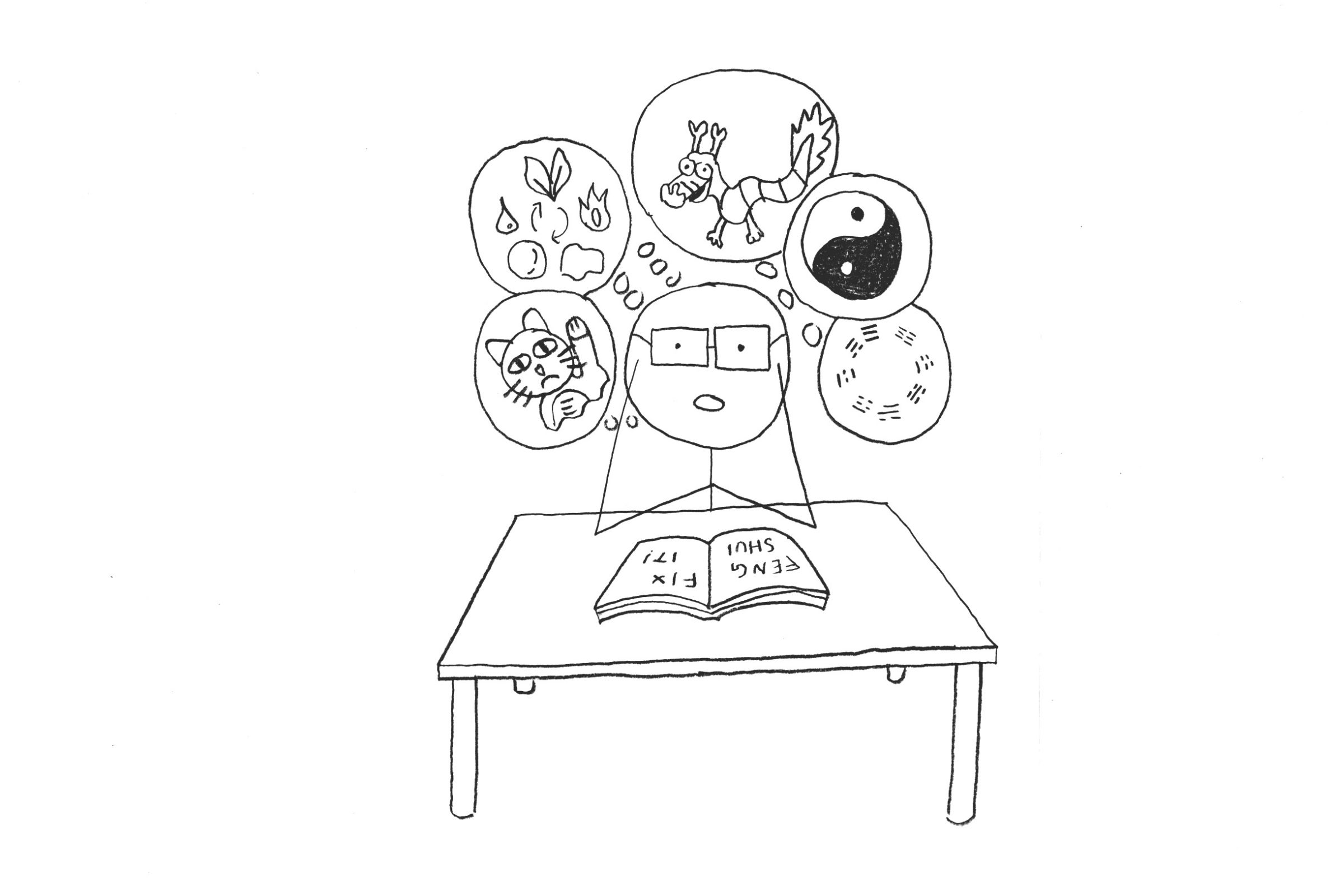
Normally, you put the cat in the money corner – the best part of the home that is visible from the entrance, deep within the home. It represents the collection of wealth. The wealth corner is where you put your Christmas tree, because it will make your home feel truly festive. It needs to be prominent, so you can see it multiple times a day.
How would you describe your own home and how it makes you feel?
I love my home so much. It’s not big, but it has great views. I have chosen homes that face south or east, because I love sunrises, and I dislike sunsets – they make me sad. I always maximise my views. I always sit in a way that I can see the window and feel connected to the city beyond. People should aim to feel good in their homes.
What does a day in your life look like?
I wake up early and go to the gym. I come back home, do some emails, have breakfast and start my first meeting at 8am.
I’m a content creator, but also an architect. I’ve stopped practising architecture now, because I do personal consultations. I meet about four or five clients a day to give them advice on their homes. I talk to them about their needs and their uses and their background. Sometimes they’re renovating, other times they’ve just moved into a rental. They’ll show me the floorplans and I’ll make suggestions.
Between client meetings, I try and find content inspiration and make videos. It’s non-stop. I give myself two days off a week, and they’re the days where I’ll do any media interviews, make content or just rest.
What do you hope people will take away from Feng Shui Fix It?
I hope it’ll help make people feel less afraid – and dismissive – of Feng Shui.
Feng Shui Fix It! 100 Solutions for a Happier Home by Cliff Tan is published by Batsford
Read more:
